
National Debt Relief Review 2026: Is It Legit? Fees, Pros & Cons

Updated October 2026
National Debt Relief is a legitimate, New York-based debt settlement company that has operated since 2009. It negotiates with your unsecured creditors to settle balances for less than you owe, and it charges a fee only after a debt is settled. It holds an A+ rating from the Better Business Bureau and strong customer reviews, but debt settlement is expensive, damages your credit, and is not the right fit for everyone.
This National Debt Relief review explains how the program works, what it really costs (with a worked $20,000 example), who qualifies, how it compares with Freedom Debt Relief, and which alternatives may serve you better.
Check if you qualify with National Debt Relief
National Debt Relief at a glance
| Feature | Details |
|---|---|
| Service type | Debt settlement (not a loan, not credit counseling) |
| Founded | 2009 (BBB lists a start date of September 23, 2009) |
| Headquarters | 180 Maiden Lane, New York, NY |
| Settlement fee | 15% to 25% of enrolled debt, depending on your state |
| Account fees | $9 one-time setup and $9.85 per month for the dedicated account |
| Minimum debt | $7,500 in unsecured debt |
| Program length | Typically 24 to 48 months |
| Not available in | Connecticut, Oregon, Vermont, West Virginia, Wisconsin |
| BBB | A+ rating, accredited since February 2013 |
| Trustpilot | About 4.7 out of 5 from more than 43,000 reviews |
| Industry memberships | Association for Consumer Debt Relief (ACDR, formerly AADR); IAPDA-certified negotiators |
Ratings and figures as of October 2026, per the BBB, Bills.com, NerdWallet and CNBC Select. Fees and availability can change, so confirm them in your enrollment agreement.
What is National Debt Relief?
National Debt Relief LLC is a for-profit debt settlement company founded in 2009 and based in Manhattan. Its BBB profile lists Daniel Tilipman as president and Alex Kleyner as CEO. The company says it has resolved more than $11.5 billion in debt for over 1.3 million clients, according to figures reported by Bills.com in October 2026.
The business model is simple. Instead of paying your credit cards each month, you save money in a dedicated account. Once enough builds up, National Debt Relief contacts your creditors and tries to get them to accept a lump sum or short payment plan that is less than the full balance. When you approve a deal and it is paid, the company collects its fee for that debt.
One point that confuses many people: National Debt Relief is not a government program. The word “National” is part of a private company’s brand name. No federal agency runs a general debt forgiveness program for credit card debt.
Is National Debt Relief legit?
Yes. National Debt Relief is a real, established company with a long operating history, a strong BBB rating and tens of thousands of public reviews. Here is what the record shows as of October 2026.
Ratings and accreditations
- Better Business Bureau: A+ rating and BBB accredited since February 5, 2013. Customer reviews on the BBB average about 4.69 out of 5 across more than 5,700 reviews.
- BBB complaints: The profile shows 544 complaints in the past three years and 132 in the last 12 months. Billing issues are the largest category.
- Trustpilot: Roughly 4.7 out of 5 from more than 43,000 reviews, per Finder (January 2026) and Bills.com (October 2026).
- ACDR: The American Association for Debt Resolution (AADR) merged with the Consumer Debt Relief Initiative in May 2025 to form the Association for Consumer Debt Relief. National Debt Relief is listed as accredited by this trade group.
- IAPDA: Its negotiators are certified through the International Association of Professional Debt Arbitrators.
Regulatory and legal record
We searched the CFPB and FTC enforcement records and found no public federal enforcement action against National Debt Relief as of October 2026. That is a meaningful difference from some competitors.
The company does face private lawsuits, which are allegations, not findings:
- Website tracking (2025): A proposed class action filed in March 2025 in federal court in Manhattan (Hantel v. National Debt Relief) alleges the company’s website shared visitor data with Meta, Google and other third parties without consent, as reported by Bloomberg Law.
- Telemarketing calls (2025): A Telephone Consumer Protection Act suit (Garcia v. National Debt Relief) was filed in December 2025 in the same court. As of the latest court records we reviewed, it was still pending.
The CFPB’s public complaint database also holds several hundred complaints about the company since 2023. Common themes include creditor lawsuits during the program, fee disputes and refund problems. That volume is not unusual for a company of this size, but it is a reminder that settlement carries real risks.
How the National Debt Relief program works
The National Debt Relief program follows the same basic path as most debt settlement plans. Here is what to expect, step by step.
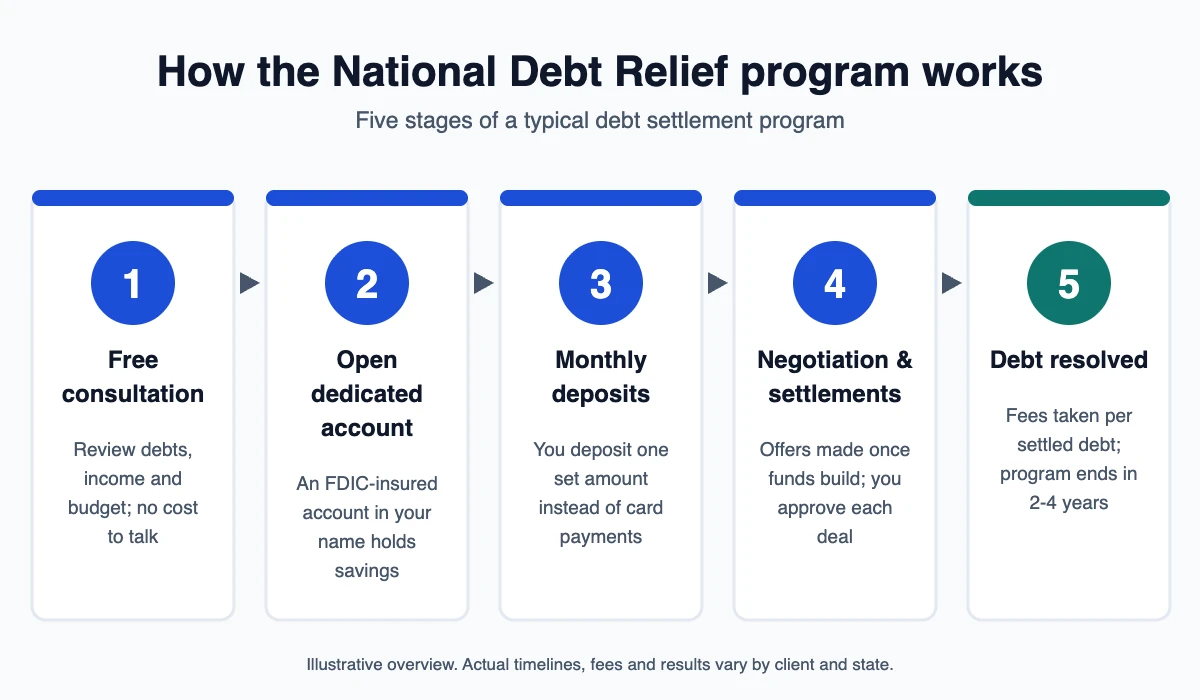
- Free consultation. A debt specialist reviews your debts, income and budget. There is no charge for this call, and you are not obligated to enroll.
- Enroll and open a dedicated account. If you qualify, you sign an agreement listing the debts to be enrolled. You then open a dedicated savings account at an insured bank. The account is in your name and you control the money in it.
- Make one monthly deposit. You stop paying enrolled creditors directly and instead deposit a set amount into the account each month. The deposit is usually lower than your combined minimum payments.
- Negotiation begins. Once enough money builds up, National Debt Relief negotiates with each creditor or collection agency. You must approve every settlement offer before it is accepted.
- Settlement and fee. The settlement is paid from your account. Only after at least one payment is made toward a settled debt can the company collect its fee for that debt.
- Repeat until finished. The process continues debt by debt. CNBC Select reports an average program length of about 34 months; most plans run 24 to 48 months.
This fee timing is not just a company policy. Under the FTC’s Telemarketing Sales Rule, debt relief companies that sell by phone have been banned from charging advance fees since October 27, 2010. They may collect a fee only after settling at least one debt, the customer agrees to the deal, and at least one payment is made. Any company that asks for money upfront is breaking the rule. See the FTC’s guidance on debt relief services.
Check if you qualify with National Debt Relief
National Debt Relief fees and costs
National Debt Relief charges a settlement fee of 15% to 25% of your enrolled debt. NerdWallet reports the standard fee is 25%, with some states capping it lower. You also pay a $9 setup fee and $9.85 per month for the dedicated account.
The company says clients who finish the program reduce their enrolled debt by an average of 20% to 25% after fees. That figure is not guaranteed and does not include people who drop out.
Worked example: $20,000 in enrolled debt
The example below is illustrative only. It assumes creditors settle for 50% of the enrolled balance, a 25% fee and a 36-month program.
| Item | Amount |
|---|---|
| Enrolled debt | $20,000 |
| Settlements paid to creditors (50%) | $10,000 |
| Settlement fee (25% of enrolled debt) | $5,000 |
| Account fees ($9 + $9.85 x 36 months) | $364 |
| Total paid | $15,364 |
| Net savings | $4,636 (about 23%) |
| Approximate monthly deposit over 36 months | About $427 |
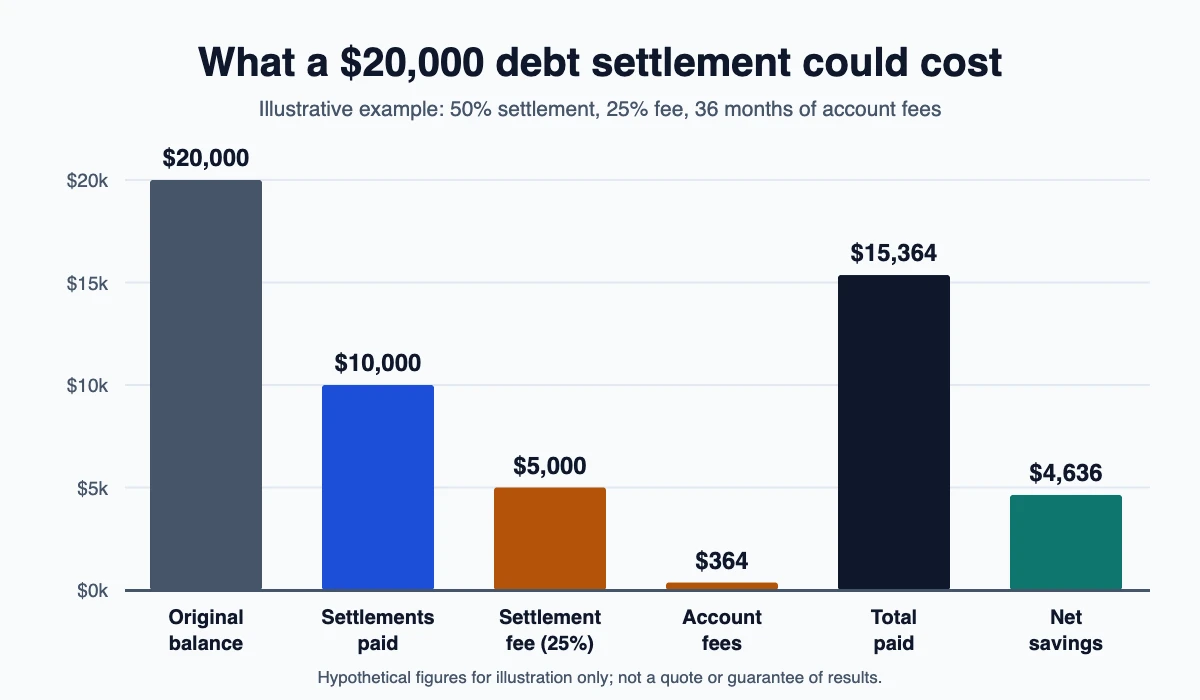
Notice that the fee is based on the enrolled balance, not the amount saved. A 25% fee on $20,000 is $5,000 whether the creditor settles for 40% or 60%. Late fees and interest that pile up while you save can also shrink your real savings, and any forgiven amount may be taxable (see below).
Who qualifies: eligible debts and states
To enroll, you generally need at least $7,500 in unsecured debt, according to NerdWallet, CNBC Select and Bills.com. One reviewer, LendEDU, cites a $10,000 minimum, so confirm the threshold during your consultation. You also need enough steady income to make monthly deposits.
National Debt Relief is not available in Connecticut, Oregon, Vermont, West Virginia or Wisconsin. Bills.com reports it serves the remaining 45 states plus Washington, D.C., Puerto Rico, Guam and the U.S. Virgin Islands.
| Usually eligible | Usually not eligible |
|---|---|
| Credit card debt | Mortgages and home equity loans |
| Unsecured personal loans | Auto loans |
| Medical bills | Federal student loans |
| Accounts in collections | Back taxes |
| Payday loans | Other secured debts |
| Repossession deficiency balances | Child support and other government debts |
| Some private student loans | Debts already in bankruptcy |
Debt settlement tends to suit people who are already behind on payments, cannot afford minimum payments, and want to avoid bankruptcy. If you are current on your bills and have good credit, other options usually cost less.
National Debt Relief pros and cons
| Pros | Cons |
|---|---|
| No fees until a debt is settled and a payment is made | Fees of up to 25% of enrolled debt |
| A+ BBB rating and strong Trustpilot reviews | Significant damage to your credit score |
| One monthly deposit instead of many bills | Creditors can sue while you save |
| You approve every settlement | Not available in five states |
| No federal enforcement action on record | Forgiven debt may be taxable |
| Can resolve debt faster than minimum payments | Savings are not guaranteed; some creditors refuse to negotiate |
Key risks to understand
- Late fees and interest: Balances can grow while you stop paying and build savings.
- Collections: Expect calls from creditors and, later, collection agencies.
- Lawsuits: A creditor may sue you before a settlement is reached. National Debt Relief does not act as your lawyer if that happens.
- Dropping out: If you leave early, you may end up with damaged credit and much of the debt still unpaid. You are entitled to the money in your dedicated account, minus fees already earned.
The CFPB cautions that settlement can leave some people deeper in debt than when they started, and it lists these same risks in its guide to debt relief programs.
How National Debt Relief affects your credit score
Debt settlement will hurt your credit, at least in the short term. There are two reasons:
- Missed payments. The program relies on you stopping payments to creditors so you can build savings. Each missed payment is reported to the credit bureaus, and late payments can stay on your report for up to seven years.
- Settled accounts. When a debt is settled, it is typically reported as “settled” or “paid for less than the full balance,” which lenders view less favorably than “paid in full.”
If your accounts are already delinquent, much of the damage may be done. Many people see their scores recover gradually once their debts are resolved and they rebuild with on-time payments. Still, expect it to be harder to get new credit, and at higher rates, for several years.
Taxes on forgiven debt
Debt that a creditor forgives is generally treated as taxable income by the IRS. If $600 or more is canceled, the creditor must send you Form 1099-C, which also goes to the IRS. In our $20,000 example, about $10,000 was forgiven, which could add meaningfully to your tax bill.
There is an important exception. If you were insolvent (your total debts were greater than your total assets) right before the debt was canceled, you can exclude forgiven debt up to the amount you were insolvent. You claim this on IRS Form 982. Read IRS Topic No. 431 on canceled debt and talk to a tax professional before you settle.
National Debt Relief vs. Freedom Debt Relief
People often search for “national freedom debt relief,” mixing up two separate companies. National Debt Relief and Freedom Debt Relief are unrelated, competing businesses, and neither is a government program. Both are private debt settlement firms with similar fees and minimums.
| Feature | National Debt Relief | Freedom Debt Relief |
|---|---|---|
| Founded | 2009 | 2002 |
| Based in | New York, NY | San Mateo, CA (per its BBB listing) |
| Settlement fee | 15% to 25% | 15% to 25% |
| Account fees | $9 setup, $9.85/month | $9.95 setup, $9.95/month |
| Minimum debt | $7,500 | $7,500 |
| Program length | 24 to 48 months | 24 to 48 months |
| Not available in | CT, OR, VT, WV, WI | CO, ND, OR, RI, VT, WV, WI, WY and D.C. |
| BBB rating | A+ | A+ |
| Trustpilot | About 4.7 (43,000+ reviews) | About 4.6 (about 49,800 reviews) |
| Debt resolved (company claim) | $11.5 billion+ | $20 billion+ |
| Federal enforcement history | None found | CFPB lawsuit (2017), settled 2019 |
Freedom Debt Relief data per CNBC Select (June 2026) and Forbes Advisor (July 2026).
The biggest difference is regulatory history. In November 2017, the CFPB sued Freedom Debt Relief, alleging it charged fees before settling debts and misled consumers about its fees and its ability to negotiate with all creditors. In 2019, the company agreed to pay $20 million in restitution and a $5 million civil penalty, according to the CFPB.
Beyond that, the two are close. National Debt Relief serves a few more states, including Colorado and Rhode Island. Freedom Debt Relief has a longer track record and a larger reported volume of resolved debt. Compare written quotes from both before choosing.
National debt consolidation: is National Debt Relief a consolidation company?
No. Despite the common search for “national debt consolidation,” National Debt Relief does not offer debt consolidation loans. It is a debt settlement company. The two approaches work very differently:
- Debt consolidation loan: You borrow a new loan from a bank, credit union or online lender, use it to pay off your cards in full, and then repay the single loan at a fixed rate. You still repay 100% of what you owe, plus interest.
- Debt settlement (National Debt Relief): You stop paying creditors, save money, and negotiate to pay less than the full balance. You pay less principal, but your credit takes a hit and you pay settlement fees.
A consolidation loan usually makes more sense if your credit is still fair to good and you can afford the payment. Settlement is aimed at people who cannot realistically repay what they owe. You can compare personal loan options in our loans section.
Alternatives to National Debt Relief
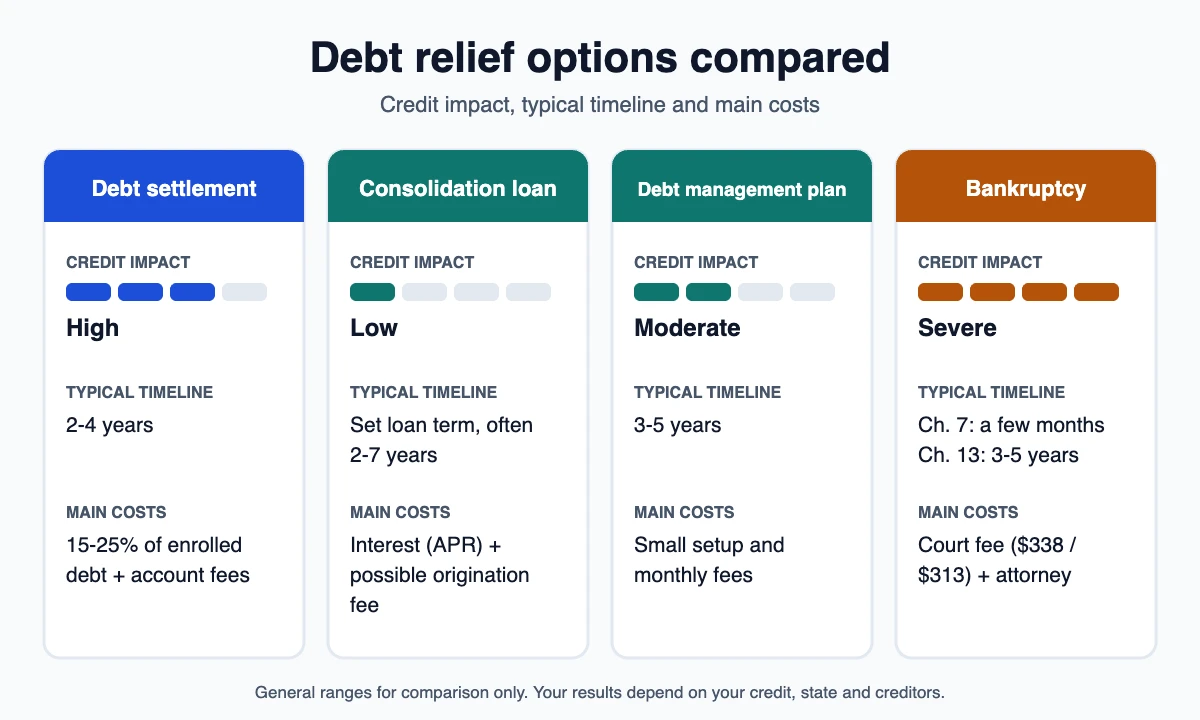
Debt settlement is one of several ways to tackle debt. Here is how the main options compare.
| Option | Credit impact | Typical timeline | Main costs | Best for |
|---|---|---|---|---|
| Debt settlement | High | 2 to 4 years | 15% to 25% of enrolled debt plus account fees | People behind on payments who cannot repay in full |
| Debt consolidation loan | Low | Set loan term, often 2 to 7 years | Interest and possible origination fee | Fair to good credit and steady income |
| Debt management plan | Moderate | 3 to 5 years | Small setup and monthly fees | People who can repay in full at lower interest rates |
| Bankruptcy | Severe | Chapter 7: a few months; Chapter 13: 3 to 5 years | Court fee ($338 for Ch. 7, $313 for Ch. 13) plus attorney fees | Overwhelming debt with no realistic way to repay |
Nonprofit credit counseling and debt management plans
A nonprofit credit counselor can review your budget for free and may set up a debt management plan (DMP). The agency asks creditors to lower interest rates and waive some fees, and you make one monthly payment to the agency. The National Foundation for Credit Counseling says DMPs usually last 36 to 60 months. You repay the full balance, but your credit is far less affected than with settlement. Find an agency through the NFCC agency finder.
Balance transfer credit cards
If your credit is still good, a 0% intro APR balance transfer card can pause interest for a set period while you pay down principal. Watch for transfer fees and the regular rate after the promotion ends. Browse options in our credit cards section.
Bankruptcy
Chapter 7 can wipe out many unsecured debts in a few months, though some assets may be sold. Chapter 13 sets up a three- to five-year repayment plan. Bankruptcy is the most damaging to credit, but it also stops most lawsuits and collection actions immediately. A bankruptcy attorney can tell you if you qualify.
Do-it-yourself negotiation
You can call creditors yourself and ask for a hardship plan, lower rate or settlement. It costs nothing but your time, and you keep the 15% to 25% fee. It works best if you have a lump sum ready and are comfortable negotiating.
National Debt Relief customer reviews
Overall customer sentiment is positive. National Debt Relief averages about 4.7 out of 5 on Trustpilot and about 4.69 out of 5 on the BBB as of October 2026.
Themes often mentioned in positive reviews:
- Friendly, patient debt specialists who explain the process clearly
- Relief from juggling many monthly bills
- Settlements that came in well below the original balances
- Regular updates as each debt is resolved
Themes often raised in complaints and BBB filings:
- Unexpected changes to deposit amounts or withdrawal timing
- Creditor lawsuits or collection pressure during the program
- Difficulty reaching the same representative
- Delays in refunds after cancelling
Read recent reviews yourself, especially low-star ones, to understand worst-case experiences.
How to enroll and avoid debt relief scams
If you decide National Debt Relief is right for you, take these steps:
- Get a free consultation and ask for a written estimate of total fees, monthly deposits and program length.
- Read the full agreement, including which debts are enrolled and how fees are calculated.
- Confirm the account is in your name at an insured bank and that you can withdraw your money.
- Ask what happens if a creditor sues and whether any legal help is available.
- Plan for taxes on forgiven debt before you approve settlements.
Watch for these red flags with any debt relief company:
- It asks for any fee before settling a debt.
- It guarantees a specific savings percentage or promises to stop all lawsuits.
- It claims to be a government program or “national” relief initiative.
- It tells you to stop talking to your creditors entirely.
- It uses a name that is similar but not identical to a known brand. The BBB lists several unrelated businesses with “National Debt Relief” in their names, so check that you are on the correct BBB profile.
For broader money tips, see our banking guides.
Bottom line: is National Debt Relief worth it?
National Debt Relief is a legitimate, well-reviewed debt settlement company with transparent fee timing, an A+ BBB rating and no public federal enforcement record. If you have $7,500 or more in unsecured debt, are already struggling with payments and want to avoid bankruptcy, it is one of the stronger options in the industry.
But it is not cheap. Fees of up to 25%, a damaged credit score, possible lawsuits and taxes on forgiven debt all cut into the savings. Before you enroll, talk to a nonprofit credit counselor and compare a consolidation loan or debt management plan. If settlement still makes the most sense, get a written quote from National Debt Relief and at least one competitor.
Check if you qualify with National Debt Relief
National Debt Relief FAQ
Is National Debt Relief legit?
Yes. National Debt Relief has operated since 2009, holds an A+ BBB rating, has been BBB accredited since 2013 and averages about 4.7 out of 5 on Trustpilot. We found no public federal enforcement action against it as of October 2026, though it faces private class action lawsuits over website tracking and telemarketing calls.
How much does National Debt Relief cost?
National Debt Relief charges 15% to 25% of your enrolled debt, depending on your state, plus a $9 setup fee and $9.85 per month for the dedicated account. Fees are charged only after a debt is settled and a payment is made.
How does the National Debt Relief program work?
You make one monthly deposit into a dedicated account in your name instead of paying creditors. Once funds build up, National Debt Relief negotiates settlements for less than you owe. You approve each deal, the settlement is paid from your account, and the company then collects its fee. Most programs last 24 to 48 months.
Is National Debt Relief a government program?
No. National Debt Relief is a private, for-profit company. “National” is part of its brand name. Be wary of any company that claims to offer a government debt relief program for credit card debt.
Is National Debt Relief the same as Freedom Debt Relief?
No. Searches for “national freedom debt relief” often mix up two separate companies. National Debt Relief is based in New York and was founded in 2009. Freedom Debt Relief was founded in 2002 and settled a CFPB lawsuit in 2019. Both offer debt settlement with similar fees, and neither is a government program.
Does National Debt Relief offer debt consolidation loans?
No. National Debt Relief is a debt settlement company, not a lender. A debt consolidation loan pays off your debts in full with a new loan, while settlement negotiates to pay less than you owe. If you want consolidation, you would apply with a bank, credit union or online lender.
Will National Debt Relief hurt my credit?
Yes, in most cases. The program requires you to stop paying enrolled creditors, which leads to late payments on your credit report, and settled accounts are reported as paid for less than the full balance. Scores can recover over time after debts are resolved.
Do I have to pay taxes on debt settled by National Debt Relief?
Possibly. Forgiven debt is generally taxable income, and creditors must send Form 1099-C for canceled amounts of $600 or more. If you were insolvent when the debt was canceled, you may be able to exclude some or all of it using IRS Form 982.
This article is for general information only and is not legal, tax or financial advice. Consider speaking with a qualified professional about your situation.
Sources: Better Business Bureau (National Debt Relief profile, October 2026); Bills.com (October 2026); NerdWallet (February 2026); CNBC Select (June and October 2026); Finder (March 2026); LendEDU (June 2026); Forbes Advisor (July 2026); Bloomberg Law (March 2025); U.S. District Court for the Southern District of New York docket via Justia; Consumer Financial Protection Bureau; Federal Trade Commission; Internal Revenue Service; National Foundation for Credit Counseling; U.S. Bankruptcy Court fee schedules; Business Wire (ACDR formation, May 2025).
networth.com may earn a commission if you sign up through links on this page. This doesn’t affect our review.