
Charles Koch Net Worth 2026: Building Koch, Inc. and Giving Away the Shares
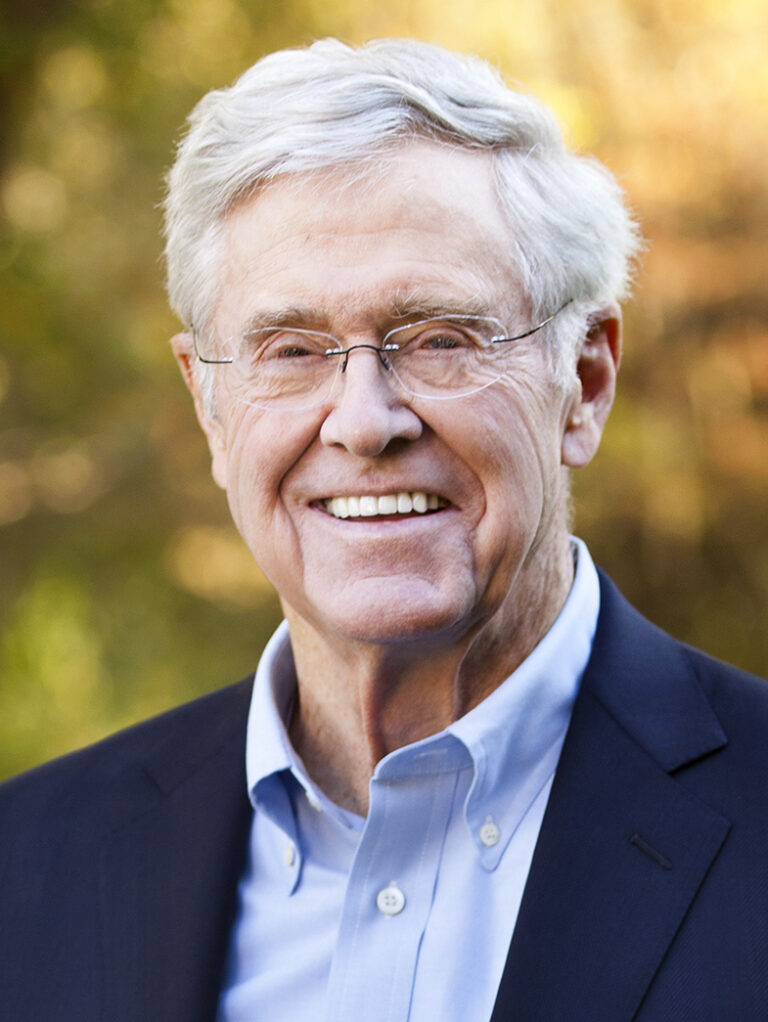
Charles Koch Net Worth
$77 Billion
Industrialist, Chief Executive, Author, Philanthropist Updated November 2026
People With a Similar Net Worth



Charles Koch’s net worth is about $77 billion, according to Forbes’ real-time tracker on November 17, 2026, which ranks him and his family No. 28 among the richest people in the world. Nearly all of it comes from Koch, Inc., the Wichita, Kansas, conglomerate known for most of its history as Koch Industries.
Charles Koch: quick facts
- Net worth
- $77 Billion
- Source of wealth
- Koch, Inc.
- Profession
- Industrialist, Chief Executive, Author, Philanthropist
- Nationality
- American
- Place of birth
- Wichita, Kansas, United States
- Date of birth
- November 1, 1935 (age 91)
Koch did not start the company, but he built it. When his father died in 1967, the family business was a mid-sized oil refiner and engineering firm. Under Charles, it grew into one of the largest private companies in America, with about $125 billion in yearly revenue, roughly 120,000 employees and businesses in pipelines, fertilizer, paper towels, glass, electronics and software.
At 91, he is still chairman and co-CEO. He is also handing over his fortune in an unusual way: he has given billions of dollars in nonvoting company stock to nonprofits and his children while keeping the voting shares that control Koch. Here is how he built the money, what he owns and where it is going.
Charles Koch at a glance
- Net worth: about $77 billion (Forbes real-time, November 17, 2026), No. 28 in the world
- Forbes 400: $76.9 billion, No. 19 in America (September 2026); $73.8 billion, No. 17 (September 2025)
- Born: November 1, 1935, in Wichita, Kansas
- Profession: industrialist, chief executive, author, philanthropist
- Company: Koch, Inc. (formerly Koch Industries), chairman and CEO since 1967, co-CEO with Dave Robertson since 2023
- Ownership: 42% of Koch’s voting power; part of his economic stake has been given away as nonvoting shares
- Education: three degrees from MIT (general engineering, nuclear engineering and chemical engineering)
- Self-made score: 5 out of 10 on Forbes’ scale (inherited a business and grew it)
- Spouse: Liz Koch (married 1972); two children, Elizabeth and Chase
- Home: Wichita, Kansas, with homes in Indian Wells, California, and Aspen, Colorado
Where Charles Koch’s money comes from
| Source | Details | Estimate |
|---|---|---|
| Koch, Inc. stake | He held 42% of the private company; he still holds 42% of the votes | The bulk of his $77 billion fortune |
| Nonvoting shares given away | $5.3 billion of nonvoting stock moved to two nonprofits between 2020 and 2022, per Forbes | No longer counted in his net worth |
| Shares passed to his children | Equal blocks of nonvoting stock given to Chase and Elizabeth Koch | Value not disclosed |
| Dividends and cash | Koch reinvests most of its profit, so payouts are modest for a company its size | Not disclosed |
| Real estate | Homes in Wichita, Indian Wells and Aspen | Not disclosed |
Charles Koch’s stake in Koch, Inc.
Koch, Inc. is privately owned, so there is no share price and no annual report. Forbes values the company from its revenue, profit estimates and comparisons with public rivals. The ownership has been stable for four decades.
| Owner | Stake | Notes |
|---|---|---|
| Charles Koch | 42% of the voting power | Economic stake slightly smaller after gifts of nonvoting stock |
| Julia Koch and her three children | 42% | Inherited from David Koch, who died in 2019 |
| Marshall family trusts | About 16% | Heirs of J. Howard Marshall II |
Because the company keeps most of its earnings, its value has compounded for decades. Forbes says Koch has invested more than $190 billion in acquisitions and upgrades since 2003. Charles’s personal fortune tracks that growth: Forbes put him at about $36 billion in 2013 and $41.3 billion in 2014, compared with $76.9 billion on the 2026 Forbes 400.
Early life
Charles de Ganahl Koch was born on November 1, 1935, in Wichita, the second of four sons of Fred and Mary Koch. His father, a chemical engineer, had developed a better way to turn heavy crude oil into gasoline and founded the family oil business in 1940.
Fred Koch was strict. He sent Charles to work on the family ranch as a boy, and Charles attended eight different schools, including military school. He then went to the Massachusetts Institute of Technology, earning a bachelor’s degree in general engineering in 1957 and master’s degrees in nuclear engineering (1958) and chemical engineering (1959).
After MIT he worked as a consultant at Arthur D. Little in Boston. He returned to Wichita in 1961 at his father’s request.
Taking over the family business (1961–1983)
Charles started at Koch Engineering, a small equipment maker within the family group, and became president of Rock Island Oil & Refining in 1966. When Fred Koch died in November 1967, Charles, then 32, became chairman and CEO. In 1968 the board renamed the company Koch Industries in his father’s honor.
His first big move came in 1969, when Koch took control of the Pine Bend refinery near St. Paul, Minnesota, by combining its stake with that of oilman J. Howard Marshall II and buying out Union Oil. Pine Bend became one of the most profitable refineries in the U.S. and paid for decades of growth. Koch added crude-oil gathering, pipelines and a refinery in Corpus Christi, Texas, bought in 1981.
The brothers’ feud
By the late 1970s the four brothers were split. Charles and his younger brother David wanted to reinvest profits; Frederick and Bill wanted more cash and challenged Charles’s control. In 1983, Charles and David bought out their brothers’ stakes. Forbes reports the price at about $800 million; other accounts put it at $1.1 billion or more.
The deal left Charles and David with 42% each. Bill Koch sued, claiming the shares had been undervalued, and the litigation dragged on until a settlement in 2001. Bill went on to build his own energy fortune; Frederick, an arts patron, died in 2020.
Building a conglomerate (1984–2020)
Charles ran Koch Industries using a system he called Market-Based Management, which treats each business unit like a small market with clear property rights, incentives and freedom to fail. He wrote about it in The Science of Success (2007) and Good Profit (2015). A core rule is to reinvest most earnings, often cited as about 90%, rather than pay them out.
That cash funded a string of big acquisitions that moved Koch well beyond oil:
| Year | Acquisition | Reported price |
|---|---|---|
| 2004 | Invista (DuPont’s fibers business, maker of Lycra at the time) | $4.4 billion |
| 2005 | Georgia-Pacific (Brawny, Quilted Northern, Dixie) | About $21 billion including debt |
| 2013 | Molex (electronic connectors) | $7.2 billion |
| 2016–2017 | Guardian Industries (glass), remaining stake | Not disclosed |
| 2020 | Infor (business software), remaining stake | Valued at about $13 billion |
Koch also bought Flint Hills Resources assets, chemical maker PetroLogistics (2014) and many smaller firms. In 2017 it set up Koch Disruptive Technologies, a venture arm led by his son Chase, to invest in areas such as health technology, semiconductors and cybersecurity.
By the 2010s Forbes and others ranked Koch as the second-largest private company in the U.S. by revenue, behind Cargill. By June 2019 Charles and David were each worth about $50 billion, tied as the 11th-richest people in the world.
Koch, Inc. and the handover (2020–2026)
David Koch retired in 2018 and died in August 2019, leaving his stake to his widow, Julia Koch, and their three children. Charles kept running the company, and in 2023 he named Dave Robertson, a longtime executive, as co-CEO. Jim Hannan became president and chief operating officer, and Chase Koch an executive vice president.
In 2024 the company dropped “Industries” from its name and became Koch, Inc., its first name change since 1968. An internal message said the new name was a better fit for a company that now earns much of its money from technology, software and consumer products. It still runs refineries in Texas and Minnesota.
The company remains active in deals. In October 2026, Getty Images announced a restructuring in which Koch Equity Development, Koch’s investment arm, would join the Getty family in putting new equity into the photo agency and taking it private.
Charles has also kept writing. Believe in People came out in 2020, and in May 2026 he and Chase published Becoming a Principle-Driven Leader.
How Charles Koch is passing on his fortune
Koch has a clear plan for his shares, which he described to Forbes in 2023. It splits votes from money.
- Nonprofits: between 2020 and 2022 he transferred $5.3 billion of nonvoting Koch stock to two nonprofits, Believe in People and CCKc4. Forbes estimates this was nearly a tenth of his 42% stake. TIME reported in May 2026 that the transfers to his network now total almost $6 billion.
- Children: he has given equal amounts of nonvoting stock to Chase and Elizabeth.
- Control: he still holds 42% of the voting power. On his death, all of his voting stock goes to Chase, matching the 42% held by David Koch’s heirs.
- The rest: after providing for his wife, Liz, the remaining shares are meant to fund the nonprofits he supports.
Forbes notes that the two nonprofits face fewer limits on lobbying and political activity than traditional private foundations. Because the shares carry no votes, the gifts do not loosen family control of the company.
Other business interests
Unlike many billionaires, Koch has few holdings outside his company. Nearly all of his time and wealth sit inside Koch, Inc., which itself owns a large investment portfolio through Koch Equity Development and Koch Disruptive Technologies.
- INTRUST Financial: Wichita bank holding company where he has been a director since 1982.
- Market-Based Management Institute: founded in 2005 to teach his management system.
- Books: four on management and one on leadership, co-written with Chase.
Real estate
Koch keeps a low profile on property. He has lived in Wichita, where Koch is headquartered, for most of his life. Forbes and the Wichita press list two other homes, but their prices have not been reported.
| Property | Year | Reported price |
|---|---|---|
| Family home, Wichita, Kansas | Decades | Not disclosed |
| Home in Indian Wells, California | Not disclosed | Not disclosed |
| Home in Aspen, Colorado | Not disclosed | Not disclosed |
Personal life
Charles married Elizabeth “Liz” Buzzi on December 23, 1972. Their daughter, Elizabeth, was born in 1975 and is a writer and publisher. Their son, Chase, was born in 1977. Chase leads Koch Disruptive Technologies, is an executive vice president of Koch, Inc. and is taking over the family’s philanthropic network.
Charles describes himself as a classical liberal. He co-founded the libertarian Cato Institute in 1977 and has backed think tanks such as the Mercatus Center and the Institute for Humane Studies. His network, led by Americans for Prosperity, has spent heavily on elections, mostly backing Republican candidates. In 2020 he said he regretted contributing to partisan division, and his network now says politics is less than 10% of its work.
He received the Ellis Island Medal of Honor in 2022 and Cato’s Milton Friedman Prize for Advancing Liberty in 2025.
Philanthropy
TIME, which named Charles and Chase Koch to its TIME100 Philanthropy list in 2026, reported that his personal giving has passed $2 billion. Most of it flows through a network he founded in 2003 that is now called Stand Together.
- Stand Together: funds groups working on criminal justice reform, education, addiction and poverty. TIME counted about 700 business leaders and more than 300 community groups in the coalition.
- Believe in People and Key Change: Chase-led initiatives that TIME said had backed more than $400 million in projects.
- Charles Koch Foundation: supports research and programs at nearly 200 U.S. colleges.
- Empowered (formerly Youth Entrepreneurs): co-founded with Liz in 1991 to teach business skills to high school students.
Koch has not signed the Giving Pledge, unlike Warren Buffett or Bill Gates, and Forbes gives him a philanthropy score of 2 out of 5. His approach is different: rather than sell shares to fund a foundation, he gives away the shares themselves and lets the company’s profits do the work.
How Charles Koch compares
Charles sits a few places behind his late brother’s family, which owns the same-sized stake but is counted as one fortune. He is close to other self-directed founders and investors in the global top 30. See more business people net worth profiles.
| Person | Net worth | Main source |
|---|---|---|
| Michael Bloomberg | $95 billion | Bloomberg LP |
| Julia Koch & family | $85 billion | Koch, Inc. |
| Jeff Yass | $78 billion | Susquehanna International Group |
| Charles Koch & family | $77 billion | Koch, Inc. |
| Tadashi Yanai & family | $71 billion | Fast Retailing (Uniqlo) |
Figures are Forbes real-time as of November 17, 2026.
The gap with Julia Koch’s family comes from Charles’s gifts of nonvoting stock, which shrank his economic share. He ranks just behind trading billionaire Jeff Yass, who like Koch funds school-choice causes, and ahead of Uniqlo founder Tadashi Yanai. Former New York mayor Michael Bloomberg, another founder of a private company, is about $18 billion richer.
Frequently asked questions
What is Charles Koch’s net worth?
Charles Koch’s net worth is about $77 billion, according to Forbes’ real-time tracker on November 17, 2026. That ranks him and his family No. 28 in the world. Forbes put him at $76.9 billion on its 2026 Forbes 400 list.
How did Charles Koch make his money?
He took over his father’s oil refining and engineering business in 1967 and built it into Koch, Inc., one of America’s largest private companies with about $125 billion in revenue. He reinvested most profits and bought companies such as Georgia-Pacific, Molex, Guardian and Infor.
Who owns Koch, Inc.?
Charles Koch holds 42% of the voting power. Julia Koch and her three children own another 42%, inherited from David Koch, and Marshall family trusts own about 16%.
Has Charles Koch given away his shares?
Partly. Between 2020 and 2022 he moved $5.3 billion of nonvoting Koch stock to two nonprofits, Believe in People and CCKc4, and he has given nonvoting shares to his two children. He kept his voting shares, which will pass to his son Chase.
Who will run Koch after Charles Koch?
Dave Robertson has been co-CEO alongside Charles since 2023. Chase Koch, his son, will inherit his father’s voting stock and is taking over the family’s philanthropic network.
Is Charles Koch richer than Julia Koch?
No. Forbes put Julia Koch and her family at about $85 billion in November 2026, compared with about $77 billion for Charles. Both families have the same voting stake, but Charles has given away billions in nonvoting shares.
Sources: Forbes (Real-Time Billionaires, November 2026; Forbes 400, September 2025 and September 2026; Koch company profile, November 2026; “Billionaire Charles Koch Shares His Secret Plan To Pass On His Fortune And Influence,” October 2023), TIME (May 2026), Axios (June 2024), Getty Images announcement (October 2026), AOL (September 2025), CharlesKoch.com timeline, Wikipedia. All net worth figures are estimates.
Charles Koch net worth over time
| Year | Net worth |
|---|---|
| 2026 | $76.9 Billion |
| 2025 | $73.8 Billion |
| 2014 | $41.3 Billion |
| 2013 | $36 Billion |