
Jensen Huang Net Worth 2026: Nvidia Stake, CEO Resignation and Return
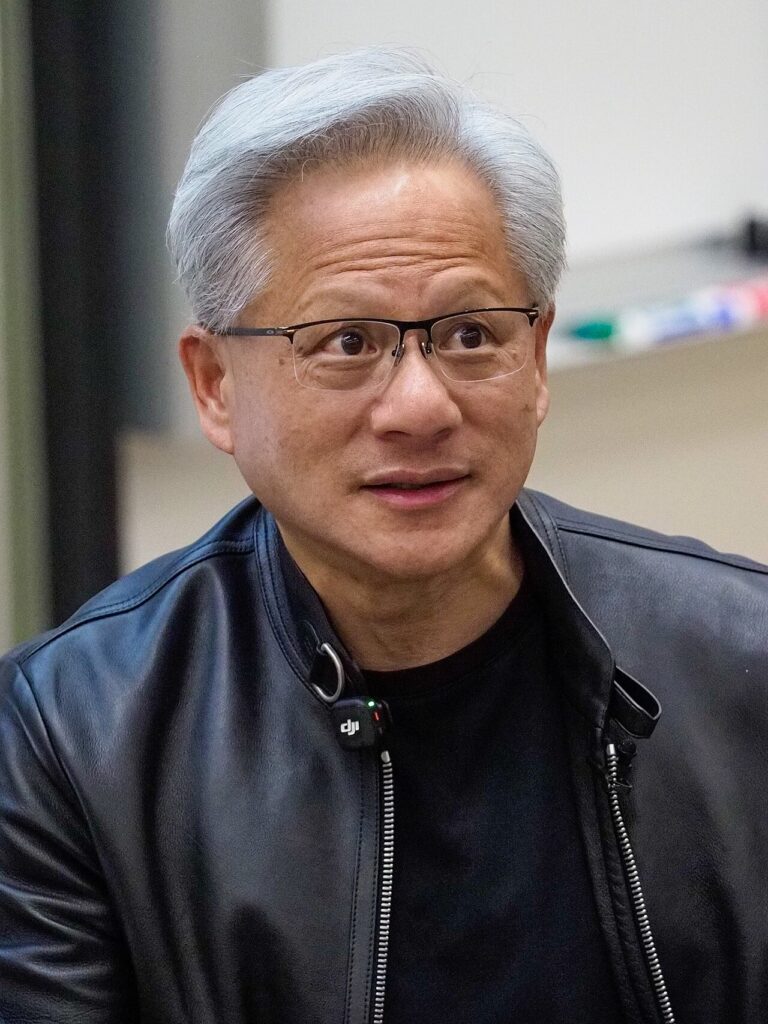
Jensen Huang Net Worth
$134 Billion
Entrepreneur, Electrical Engineer, CEO Updated November 2026
People With a Similar Net Worth





Jensen Huang’s net worth is about $134 billion, according to Forbes’ real-time tracker on November 17, 2026, which ranked him No. 14 among the richest people in the world. Nearly all of that money is his stake of roughly 3.5% in Nvidia, the chipmaker he co-founded in 1993 and has run for most of the 33 years since.
Jensen Huang: quick facts
- Net worth
- $134 Billion
- Salary / earnings
- $2 Million per year
- Source of wealth
- Nvidia
- Profession
- Entrepreneur, Electrical Engineer, CEO
- Nationality
- American, Taiwanese
- Place of birth
- Taipei, Taiwan
- Date of birth
- February 17, 1963 (age 63)
Few fortunes have moved as fast. Forbes valued Huang at $77 billion in March 2024 and $154 billion in March 2026, and he passed $200 billion in early October 2026 as Nvidia stock hit records on demand for AI chips. Then a scandal over his personal relationships, and reported national-security concerns, sent Nvidia shares sharply lower in November.
Huang resigned as CEO on November 12, 2026, and the board reinstated him on November 23. Forbes’ figure fell to about $113 billion on November 20 and bounced to about $144 billion when he returned. Here is how he built the fortune, what he owns and why it has swung so much.
Jensen Huang at a glance
- Net worth: about $134 billion (Forbes real-time, November 17, 2026), No. 14 in the world
- Forbes lists in 2026: $154 billion on the World’s Billionaires list (March, No. 8); No. 8 on the Forbes 400 (September)
- Born: February 17, 1963, in Taipei, Taiwan
- Profession: electrical engineer, entrepreneur, CEO
- Company: Nvidia (co-founder; president and CEO since 1993, apart from November 12–23, 2026)
- Nvidia stake: more than 3.5% (Forbes), the largest individual holding; mostly held in trusts with his wife
- Pay: $36.3 million in total compensation for fiscal 2026; base salary raised to $2 million for fiscal 2027
- Education: B.S. in electrical engineering, Oregon State University (1984); M.S. in electrical engineering, Stanford University (1992)
- Awards: IEEE Founders Medal (2020), Queen Elizabeth Prize for Engineering (2025), one of Time’s Persons of the Year as an “Architect of AI” (2025), IEEE Medal of Honor (2026)
- Spouse: Lori Huang (née Mills), married 1985; two children, Spencer and Madison
- Citizenship: United States and Taiwan
Where Jensen Huang’s money comes from
| Source | Details | Estimate |
|---|---|---|
| Nvidia shares | More than 3.5% of the company, held directly and through family trusts | Most of his $134 billion; each $10 move in the stock shifts it by about $8 billion |
| Cash from share sales | Pre-scheduled sales under Rule 10b5-1 trading plans | $713 million in 2024; a plan for up to 6 million more shares in 2025 |
| Salary and bonus | Pay as Nvidia’s CEO, mostly in stock awards | $36.3 million in fiscal 2026 |
| Real estate | Homes in Los Altos Hills, San Francisco and Maui | $38 million reported for the San Francisco house |
| Foundation (not counted in his net worth) | Jen-Hsun & Lori Huang Foundation | More than $12 billion in assets by late 2025 |
Jensen Huang’s Nvidia stake
Unlike the Google or Meta founders, Huang has no super-voting shares. Nvidia has a single class of stock, so his power comes from his record and his large but minority stake. Forbes says he owns more than 3.5%; Bloomberg puts it at about 3.4%, based on a September 2026 filing.
Most of the shares sit in trusts where Huang and his wife are co-trustees, according to Nvidia’s 2026 proxy statement. In March 2026 two family trusts set up in 2016 passed 58.96 million shares, then worth more than $10 billion, to a long-term irrevocable trust. Reports say its beneficiaries are believed to be the couple’s children.
Because almost everything he owns is Nvidia stock, his wealth tracks the share price closely. Big moves in his fortune include:
- March 2024: $77 billion on Forbes’ annual list (No. 20), after Nvidia’s market value first passed $1 trillion in 2023.
- March 2025: $98.7 billion (No. 16), after a second year of AI-fuelled growth.
- October 2025: Nvidia became the first public company worth more than $5 trillion.
- March 2026: $154 billion on Forbes’ annual list (No. 8).
- Early October 2026: passed $200 billion as Nvidia stock closed at a record.
- November 12–23, 2026: fell to about $113 billion during the CEO crisis, then rose about $34 billion in a single day when he was reinstated.
Share sales and pay
Huang sells stock slowly and on a schedule. He sold 6 million shares for about $713 million in 2024, and in March 2025 Nvidia disclosed a plan for him to sell up to another 6 million shares by the end of that year, worth roughly $865 million to $925 million depending on the price. Form 4 filings show no open-market sales by him in 2026, only shares withheld for tax and gifts to charity.
His pay is small next to his stake, but large by most standards:
| Fiscal year | Total compensation | Notes |
|---|---|---|
| 2024 (ended January 2024) | $34.2 million | Mostly stock awards |
| 2025 | $49.9 million | Rose with revenue and the share price |
| 2026 | $36.3 million | Down 27% on smaller stock awards; $24.8 million in stock |
| 2027 (current) | Not yet reported | Base salary raised from $1.5 million to $2 million, plus a bonus of up to $4 million tied to targets |
Early life
Jen-Hsun Huang was born on February 17, 1963, in Taipei, Taiwan. His father was a chemical engineer and his mother a schoolteacher. The family moved to Thailand when he was about five.
At nine he and his older brother were sent to the United States to live with an uncle in Tacoma, Washington. The family mistakenly enrolled the boys at Oneida Baptist Institute in rural Kentucky, thinking it was a boarding school; it was in fact a strict religious reform academy. About two years later his parents arrived and the family settled in Beaverton, Oregon.
Huang skipped two grades and finished Aloha High School at 16. From 1978 to 1983 he worked at Denny’s as a dishwasher, busboy and waiter. He earned an electrical engineering degree from Oregon State University in 1984, where he met his future wife, Lori Mills, who was his lab partner.
Chip designer to founder (1984–1993)
After college Huang designed microprocessors at AMD, then moved to LSI Logic, where he rose to direct a division. He studied at night and earned a master’s degree from Stanford University in 1992.
At LSI he met engineers Chris Malachowsky and Curtis Priem. The three met at a Denny’s in East San Jose to plan a company that would build chips for 3D graphics, then a niche used mainly for video games. They signed Nvidia’s incorporation papers on April 5, 1993, and Huang, then 30, became president and CEO on day one.
Building Nvidia (1993–2012)
Nvidia nearly failed early on. Its first chip sold poorly, and an investment of $5 million from Sega kept it alive. The RIVA 128 in 1997 was its first hit, and Huang often told staff the company was “thirty days from going out of business.”
Backed by Sequoia Capital and Sutter Hill Ventures, Nvidia went public in January 1999. Later that year it launched the GeForce 256, which it marketed as the world’s first GPU, or graphics processing unit. GeForce cards became the standard for PC gamers.
The bet that made Huang a billionaire many times over came in 2006, when Nvidia released CUDA, software that let researchers use its graphics chips for general computing. For years Wall Street saw it as an expensive side project. In 2012 the AlexNet image-recognition model was trained on Nvidia GPUs, and deep-learning researchers began buying them in bulk.
The AI boom (2013–2025)
Nvidia turned that lead into data-center chips for AI. It bought the networking firm Mellanox for about $6.9 billion in 2020; a $40 billion deal for chip designer Arm collapsed in 2022 under regulatory pressure.
The launch of ChatGPT in late 2022 set off a race among tech giants to buy Nvidia’s chips. Customers included Microsoft, Meta, Google, Amazon, Oracle and Elon Musk‘s xAI. Nvidia passed a $1 trillion market value in May 2023, $4 trillion in July 2025 and $5 trillion in October 2025.
Revenue rose from about $4.1 billion in fiscal 2014 to $215.9 billion in fiscal 2026. Huang, known for his black leather jacket and long keynote talks, became one of the most recognised executives in the world, and his net worth rose roughly fivefold in two years.
2026: record highs, resignation and return
The year started strongly. Huang received the IEEE Medal of Honor in January and was named to President Donald Trump‘s science and technology advisory council, PCAST. Nvidia stock closed at a record in early October, lifting his fortune above $200 billion.
On October 29, The New York Times reported that U.S. officials believed Alice Huang, an executive at Singapore-based Megaspeed, was passing information to Beijing and had a “close relationship” with Jensen Huang. China called the report baseless. On November 8, Huang told employees he had been unfaithful to his wife and apologised. Nvidia’s board opened an investigation, led by independent directors, into whether he had been the target of a foreign intelligence effort, and said it had no reason to believe national security or company secrets had been compromised.
Further reports followed about relationships with Nvidia employees, which Huang did not confirm. On November 12 Nvidia announced that he had resigned as president, CEO and director. CFO Colette Kress became interim CEO, and Harvey Jones became board chair. Nvidia shares fell as much as 14% that day.
Kress presented quarterly results on November 17: revenue of $115.8 billion, up 103% from a year earlier, and a forecast of $130 billion for the next quarter. In the days that followed, reports of an SEC inquiry and a subpoena from California’s attorney general pushed the stock lower, and Forbes’ estimate of Huang’s wealth fell to about $113 billion on November 20. Bloomberg’s index put him at $105 billion at that day’s close.
On November 23 the board unanimously reinstated Huang as president, CEO and director, saying it had consulted senior U.S. government officials and was confident his return posed no national security risk. Trump said he had encouraged the board to bring him back. The board’s investigation continues, and Huang is due to give a closed-door interview to House committees on December 1. Nvidia shares jumped about 31% that day, adding roughly $34 billion to his fortune.
Business ventures and investments
Huang has built his wealth almost entirely inside one company. He has not set up a large venture fund or bought sports teams, as several peers have. Nvidia itself, however, has become a major investor in AI startups and cloud providers, often among its own customers.
- Nvidia: his only major business, worth more than $4 trillion in late November 2026.
- Industry partnerships: Nvidia supplies AI systems to companies including Oracle, founded by Larry Ellison, and Meta, run by Mark Zuckerberg. Both men’s fortunes also rose sharply on AI spending.
- Personal investments: no large outside holdings have been disclosed.
Real estate
Huang has kept a fairly modest property profile for a man of his wealth. Reported homes include:
| Property | Year | Reported price |
|---|---|---|
| Family home, Los Altos Hills, California | 2003 | Not disclosed |
| Second home, Wailea, Maui, Hawaii | 2004 | Not disclosed |
| Mansion, San Francisco (bought through an LLC) | 2017 | $38 million |
Before Nvidia’s 1999 IPO the family lived in starter homes in San Jose. Forbes lists his residence as Los Altos, California.
Personal life
Huang married Lori Mills in 1985, the year after they graduated from Oregon State. Their two children, Spencer and Madison, both work at Nvidia, in product management and product marketing. He is also a distant cousin of AMD CEO Lisa Su, a rival in the chip business.
In his November 2026 message to staff, Huang admitted being unfaithful to his wife and apologised to his family. Lori Huang has not commented publicly, and no divorce has been filed. Because the couple live in California, a community property state, Forbes has noted that assets built during the marriage would generally be split equally in any divorce, unless an agreement says otherwise. Huang has said his wife “has been part of Nvidia every step of the way.”
Philanthropy
The Jen-Hsun & Lori Huang Foundation, set up in 2007, is funded mainly with Nvidia stock. Its assets passed $12 billion by late 2025, largely because of the rise in Nvidia shares. In 2026 alone, filings show Huang gave about 838,000 Nvidia shares to the foundation and a donor-advised fund.
- Stanford University: $30 million for the Jen-Hsun Huang Engineering Center.
- Oregon State University: $50 million in 2022 toward a research center that bears his name, home to a new supercomputer.
- California College of the Arts: matched a $22.5 million campaign in 2025.
- Other grants have gone to the Monterey Bay Aquarium and the AI-education nonprofit AI4ALL.
Forbes gives him a philanthropy score of 1 out of 5, meaning he has given away less than 1% of his fortune.
How Jensen Huang compares
Huang is one of several tech founders near the top of the global rich list. He trails former Microsoft CEO Steve Ballmer but sits ahead of Microsoft co-founder Bill Gates, whose fortune has been shrunk by decades of giving. See more business people profiles.
| Person | Net worth | Main source |
|---|---|---|
| Steve Ballmer | $156 billion | Microsoft |
| Jensen Huang | $134 billion | Nvidia |
| Bill Gates | $121 billion | Microsoft, Cascade Investment |
| Changpeng Zhao | $115 billion | Binance |
All figures from Forbes’ real-time tracker on November 17, 2026. Huang’s estimate rose to about $144 billion on November 23, 2026, after his reinstatement.
Huang’s wealth is far more volatile than Gates’s or Ballmer’s, because it sits in one fast-moving stock. Crypto founder Changpeng Zhao is just behind him, but Zhao’s figure depends on an estimated value for a private company rather than a share price.
Frequently asked questions
What is Jensen Huang’s net worth?
Jensen Huang’s net worth is about $134 billion, according to Forbes’ real-time tracker on November 17, 2026, which ranked him No. 14 in the world. Nearly all of it is his stake of more than 3.5% in Nvidia.
How much of Nvidia does Jensen Huang own?
Forbes says Huang owns more than 3.5% of Nvidia, and Bloomberg puts it at about 3.4%. Most of the shares are held in trusts he and his wife control. He is Nvidia’s largest individual shareholder.
Is Jensen Huang still the CEO of Nvidia?
Yes. He resigned on November 12, 2026, amid a scandal over his personal relationships and reported national-security concerns, and CFO Colette Kress served as interim CEO. Nvidia’s board reinstated him as president, CEO and director on November 23, 2026, while its investigation continues.
How much does Jensen Huang get paid?
Huang’s total compensation was $36.3 million in fiscal 2026, down from $49.9 million the year before, and most of it was stock. His base salary was raised to $2 million for fiscal 2027, with a bonus of up to $4 million if Nvidia hits its targets.
How did Jensen Huang get so rich?
He co-founded Nvidia in 1993 and has led it ever since. Its graphics chips and CUDA software became the main hardware for training AI models, and Nvidia’s market value rose past $5 trillion in 2025, lifting his stake with it.
Has Jensen Huang given money to charity?
Yes. His family foundation held more than $12 billion in assets by late 2025. He has given $30 million to Stanford, $50 million to Oregon State University and gifts to arts and AI-education groups, though Forbes says he has given away less than 1% of his wealth.
Sources: Forbes (Real-Time Billionaires, November 2026; World’s Billionaires lists, March 2024, 2025 and 2026; Forbes 400, September 2026; November 2026 reports), Bloomberg Billionaires Index via FinanceFeeds (November 2026), Nvidia press releases and SEC filings (November 2026), Bloomberg Law (May 2026), Fortune (March 2026), Tom’s Hardware (2025), Al Jazeera, Men’s Journal via Yahoo Finance, Wikipedia. All net worth figures are estimates.
Jensen Huang net worth over time
| Year | Net worth |
|---|---|
| 2026 | $154 Billion |
| 2025 | $98.7 Billion |
| 2024 | $77 Billion |